What if renewable energy companies made housing a whole-of-business consideration?
This case study is one of a series looking at how the shift to renewable energy can enable improved housing outcomes for regional communities. It showcases examples of innovative workforce accommodation and legacy housing initiatives from across Australia.
Housing legacy: This project delivers new workforce accommodation in Gracemere and Rockhampton, designed with the capacity to transition into future permanent housing.
Energy Estate, a clean energy and infrastructure company, and Hinman Group, a workforce accommodation developer, came together to create a new organisation, Accommodation Solutions Australia. The aim: to develop workforce accommodation and legacy housing projects in regional Australia.
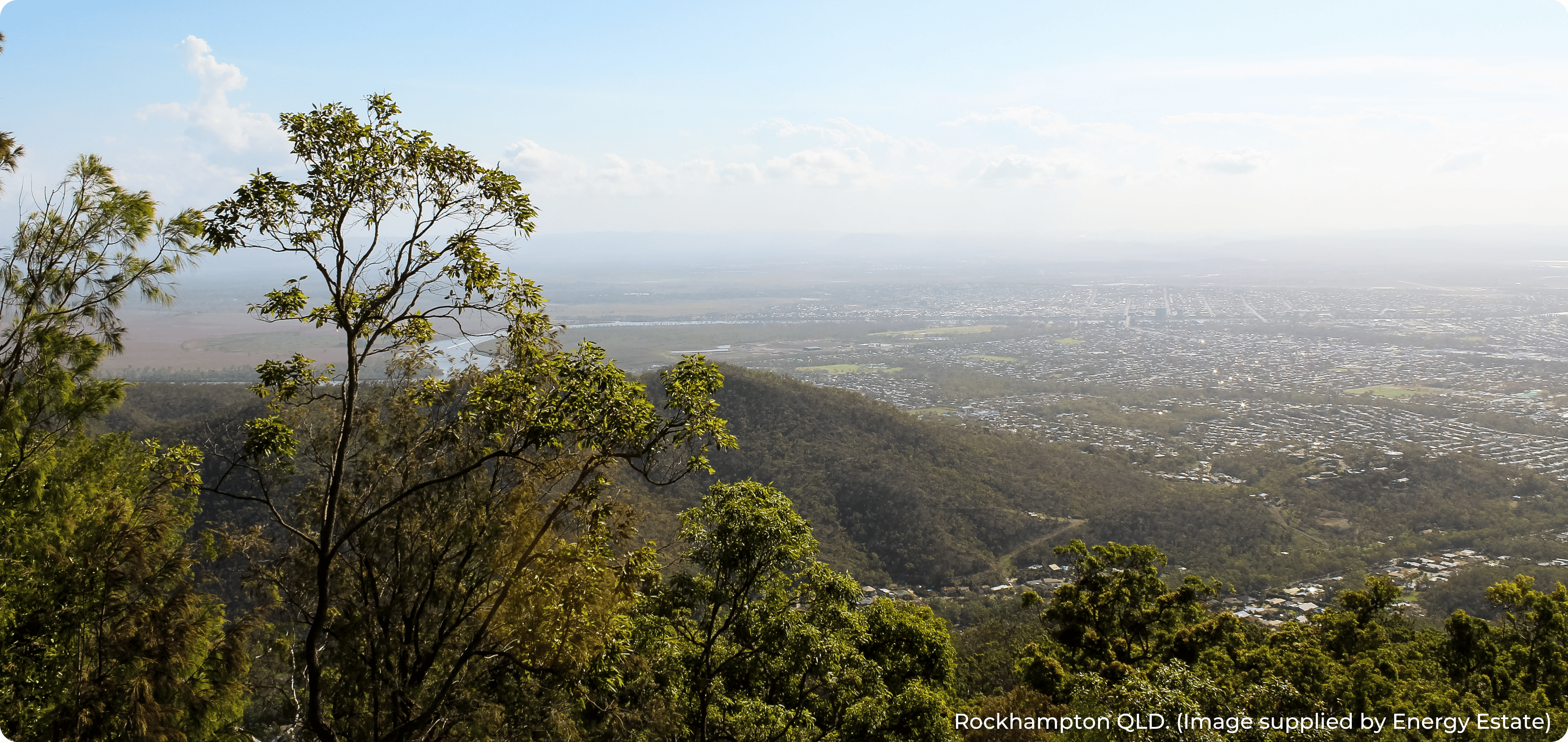
The first two villages are located in Rockhampton and Gracemere, Queensland. These projects aim to address current housing shortages while supporting the region’s growing renewable energy sector and other large-scale infrastructure projects.
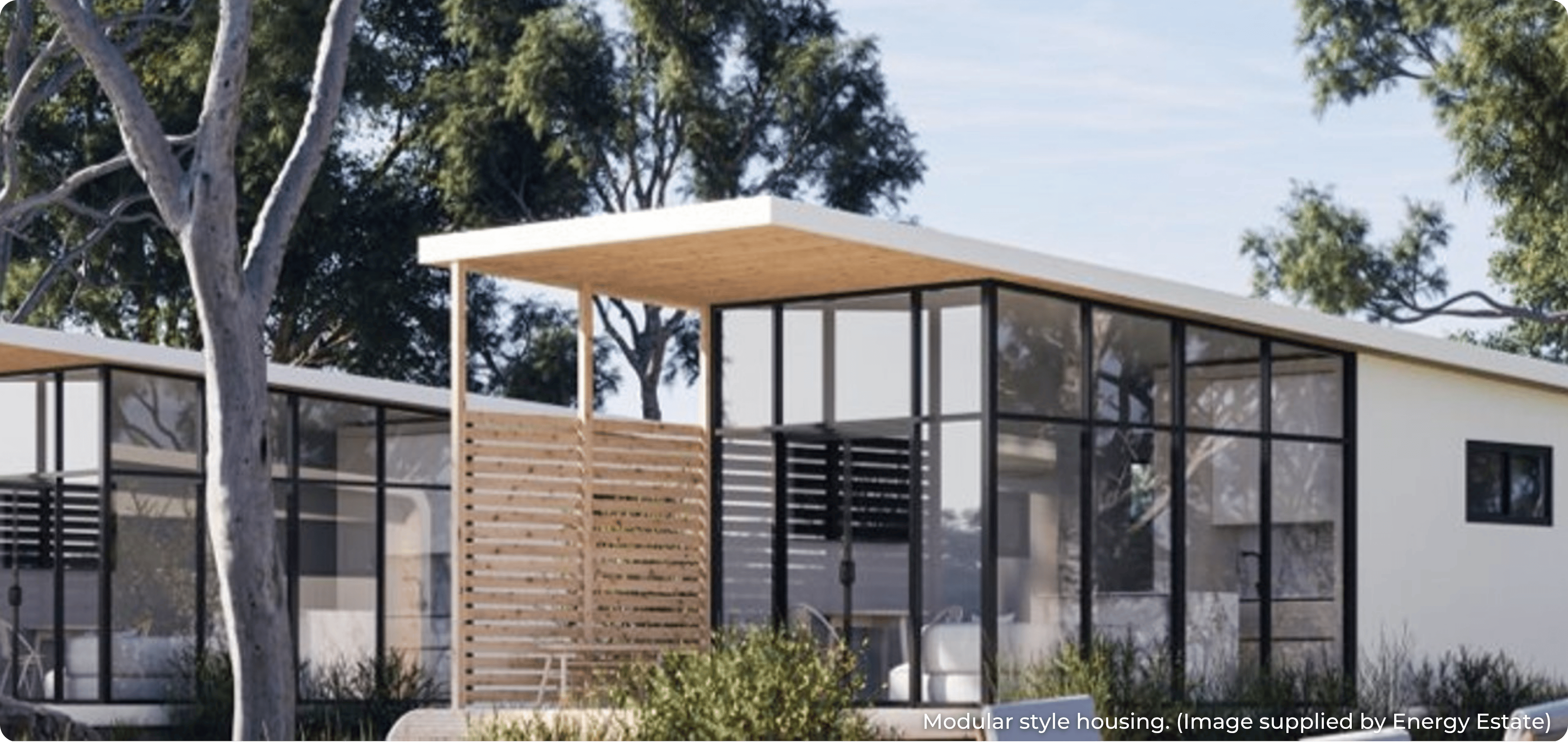
Homes are designed with floor plans that accommodate temporary workers living in single rooms, with the capacity to transition into legacy homes with space for families. Rather than building prefabricated, temporary units that will later be removed, Accommodation Solutions Australia is aiming to build high-quality homes in locations that will become new permanent suburbs.
LOCAL CONTEXT
With populations of around 63,000 and 11,500 respectively, Rockhampton and nearby Gracemere play a central role in Queensland’s energy, agriculture and heavy industry sectors.
The region is a critical service hub for coal operations across the Bowen, Galilee and Surat Basins and hosts the Stanwell Power Station. The area has historically experienced boom-bust housing cycles driven by its dependence on mining employment.
The broader Capricorn region has a number of renewable energy projects already underway, and several new projects under planning and development. However, the region is facing a significant housing crisis, with the rental vacancy rate regionally just 0.8% (as of April 2025)¹ and rental prices rising 27% in 2024.²
CHALLENGES THE PROJECT IS SEEKING TO ADDRESS
The project aims to avoid exacerbating previous boom-bust housing cycles experienced locally, by delivering workers’ accommodation that can be easily transitioned to long-term housing. However, temporary accommodation and prefabricated housing is often seen as low-quality, partly due to historical stigma about this construction style.³
Similarly, short-term worker camp operators often have little incentive to invest in well-designed, comfortable living environments – especially when doing so raises costs.
The Gracemere and Rockhampton projects are seeking to demonstrate that with careful planning, prefabricated housing can offer sustainable, high-quality, liveable homes and neighbourhoods. The project also provides an opportunity for renewable energy companies to lead by example, ensuring homes are energy-efficient, powered by rooftop solar and supportive of electric vehicles.
WHAT HAPPENED
In planning for its renewable energy workforce, Energy Estate identified a significant housing shortage challenge in Central Queensland. So they created a joint venture with an experienced construction and civil works company – the Hinman Group – to deliver long-term housing for the region.
This joint venture – named Accommodation Solutions Australia – has a bigger picture focus to deliver workforce accommodation designed to transition to long-term housing across Australia, beginning in Central Queensland. Planning for each location incorporates a workforce village, including recreational spaces and landscaping.
The Gracemere site is designed with the potential to deliver 305 legacy homes
The Rockhampton project is designed with the potential to deliver 648 legacy homes.
KEY BENEFITS THE PROJECT SEEKS TO DELIVER
- Delivering sustainable building design, housing diversity and infrastructure such as electric vehicle charging stations within workers’ accommodation
-
Generation of new business and new opportunities for local supply chain partners and supporting local workforce capacity building
LEARNINGS FOR BROADER APPLICATION
Renewable energy companies often engage third parties to take responsibility for construction-phase workforce accommodation. These contractors have less incentive to deliver best-practice accommodation solutions or to consider their long-term standing in a community, as their involvement in the region is time-limited.
Energy Estate has made a commitment to approach the need for temporary workers' accommodation as an opportunity to contribute to the communities they have a long-term interest in. By considering this as a core component of their own operations, they were able to partner with the Hinman Group to address regional housing needs, rather than a focus on project-by-project solutions.
The process and regulatory framework for developing temporary workers’ accommodation is more established in Central Queensland than other areas, due to the long history of mining in the region.
The Queensland Government requires that companies consider cumulative workforce management, housing and accommodation, local business and industry procurement, and health and community well-being as part of social impact assessment.⁴
This requirement is complemented by the Major Resource Housing Policy, which sets additional principles for companies to consider in addressing housing supply and affordability.⁵ As these requirements are increasingly rolled out to apply to renewable energy projects, this project is moving beyond simple compliance – it is seeking to deliver housing that is reducing environmental footprint through energy-efficient buildings, waste reduction and water conservation. This sets high standards for workers’ accommodation, allowing for easier transformation into future legacy housing.
New housing builds provide an opportunity to not only support existing local businesses, such as catering and site management, but to build new local industries and supply chains. For these projects, Accommodation Solutions Australia is directly working with Australian manufacturers to source the build components domestically and use local suppliers.
Accommodation Solutions Australia is also exploring options for a manufacturing hub in Gracemere for construction components of modular homes, with an associated training facility. If successful, this means the project will not only deliver legacy housing, but will also provide legacy business development opportunities.
Read more examples of innovative workforce accommodation and legacy housing initiatives in the shift to renewable energy in our full report.
¹ Real Estate Investor, ‘Investment Property Rockhampton City, QLD, 4700’ (April 2025) <https://www.realestateinvestar.com.au/property/rockhampton+city>.
² Marcia Gil, ‘Booming but Still a Bargain: Big Little Queensland City Has $350,000 House Prices’, Domain 3 February 2025, https://www.domain.com.au/news/booming-but-still-a-bargain-big-little-city-has-houses-that-cost-350000-1347696/
³ Dale A Steinhardt and Karen Manley, ‘Exploring the Beliefs of Australian Prefabricated House Builders’ (2016) 16(2) Construction Economics and Building 27.
⁴ State Department, Infrastructure and Planning, ‘Social Impact Assessment’, State Development, Infrastructure and Planning (2020) <https://www.statedevelopment.qld.gov.au/coordinator-general/strong-and-sustainable-resource-communities/social-impact-assessment>.
⁵ Infrastructure, Planning and Natural Resources Committee, Inquiry into Fly-in, Fly-out and Other Long Distance Commuting Work Practices in Regional Queensland (No Report No. 9, 55th Parliament, October 2015) <https://documents.parliament.qld.gov.au/committees/IPNRC/2015/FIFO/02-rpt-009-09Oct2015.pdf>.
Banner image: Dulacca Wind Farm QLD.